

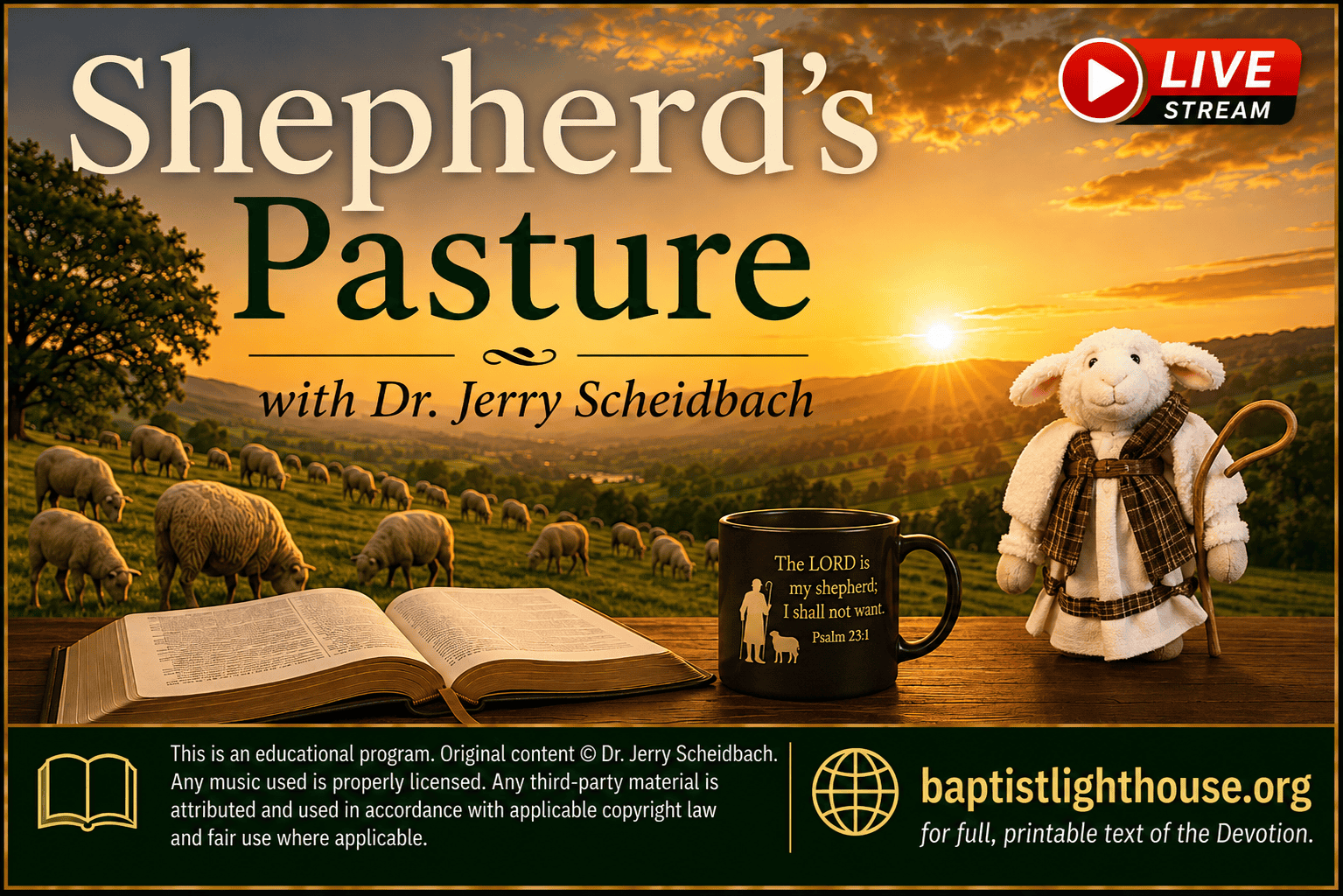
I’ll use Psalms 8:1, 16:2, and 31:1-3 for Temple worship today.
My Shepherd met me in His green pastures, contemplating His letter to Sardis (Revelation 3:1-6). The Mind of the Spirit engaged the spirit of my mind in his advice and warning recorded at Revelation 3:1-3:
Revelation 3:1 ¶ And unto the angel of the church in Sardis write; These things saith he that hath the seven Spirits of God, and the seven stars; I know thy works, that thou hast a name that thou livest, and art dead.
Revelation 3:2 Be watchful, and strengthen the things which remain, that are ready to die: for I have not found thy works perfect before God.
Revelation 3:3 Remember therefore how thou hast received and heard, and hold fast, and repent. If therefore thou shalt not watch, I will come on thee as a thief, and thou shalt not know what hour I will come upon thee.
Along the still waters, I reflected on His rebuke: your name (reputation) does not honestly reflect your game (performance). I remembered the scene in “Moneyball” where character Billy Beane challenges the staunch baseball establishment talent scouts with the line, “If he’s a good hitter, why doesn’t he hit good?” According to appearances, the hitter in question had great form and follow-through in his swing. But the performance statistics showed that he performed poorly.
If the church at Sardis had a reputation for being “alive,” why was it dead?
The analogy is poignant. In Sardis, most church members and others would say the church was alive. By any appearance-based assessment, it was. But by Jesus’ assessment, the church was dead. The difference between the Moneyball illustration and Sardis is where we come to the rub: when a church looks alive but is dead, Satan has, at a minimum, neutralized the influence of that church in the lives of its members and in the community, and at worst, become a deadening influence upon the conscience of saints and sinners. The eternal consequence is devastating.
Sadly, Jesus did not hold out much hope for this church’s recovery: “Be watchful, and strengthen the things which remain, that are ready to die” (Revelation 3:2). Repentance is not always followed by restoration; sometimes it only staunches further erosion (Revelation 3:3).
Once again, Jesus separates those who had not defiled their garments from those who had, and promises that they will walk with Him in white, “for they are worthy” (Revelation 3:4). Hear the exhortation of the Spirit: “I therefore, the prisoner of the Lord, beseech you that ye walk worthy of the vocation wherewith ye are called” (Ephesians 4:1; see Colossians 1:10, and 1 Thessalonians 2:12).
Like Pergamos and Thyatira, Jesus warns the church to consider their condition in light of His return for the saints: “If therefore thou shalt not watch, I will come on thee as a thief, and thou shalt not know what hour I will come upon thee” (Revelation 3:3b). Interesting, here Jesus implies that the saints should live in such expectation of His return, it will not catch them unprepared (1 John 2:28).
What kills a church? Not living in the expectation of His return, and so relaxing into the “world” where their garments are defiled.
In the valley, shadowed by His Cross, Jesus cried out: “If any man will come after me, let him deny himself, and take up his cross daily, and follow me” (Luke 9:23). The irony was palpable! The surest way to keep our “garments” clean and avoid Sardis-death is to live dead (Galatians 2:20-21; Romans 6:11).
At the table, my Shepherd anointed my head with His oil and mixed His sufficient grace into my cup. Goodness and mercy attended me as I followed the steps of my Saviour into the harvest.
Praying for revival! 🙏
Going live asap:
Greetings in the Mighty Name of our LORD AND SAVIOR, JESUS CHRIST!!
My name is Tatsuo Akamine. I live in Southern California in a city called Gardena.
I attend First Baptist Church of Lomita. I just recently picked up your book, “Kingdom Power by PRAYER & FASTING.”
My wife bought a copy when Bro. Benny Beckham came to our church to speak.
Your book is a great reminder that our struggle is not against “Flesh & Blood.” (Eph. 6:12) and the “weapons of our warfare are not carnal, but mighty through God to the pulling down of strongholds…”(2Cor10:4).
The mighty weapon of prayer & fasting is largely forgotten in our day.
The consequences of this neglect are apparent & devastating as you outline in your book.
I intend to let out pastor, Rick Garland, borrow this book. He has a burden for REVIVAL beginning with our small church.
Thank you, dear brother, for your faithful service to our LORD!!! (Heb.6:10)
For the End Time Harvest,
Tatsuo Akamine
Greetings in the Mighty Name of our LORD AND SAVIOR, JESUS CHRIST!!
My name is Tatsuo Akamine. I live in Southern California in a city called Gardena.
I attend First Baptist Church of Lomita. I just recently picked up your book, “Kingdom Power by PRAYER & FASTING.”
My wife bought a copy when Bro. Benny Beckham came to our church to speak.
Your book is a great reminder that our struggle is not against “Flesh & Blood.” (Eph. 6:12) and the “weapons of our warfare are not carnal, but mighty through God to the pulling down of strongholds…”(2Cor10:4).
The mighty weapon of prayer & fasting is largely forgotten in our day.
The consequences of this neglect are apparent & devastating as you outline in your book.
I intend to let out pastor, Rick Garland, borrow this book. He has a burden for REVIVAL beginning with our small church.
Thank you, dear brother, for your faithful service to our LORD!!! (Heb.6:10)
For the End Time Harvest,
Tatsuo Akamine